Evidence Based Consultation (EBC LLC) NPI Porivder Identity 1639783574

The Neuroscience of the "Mini-Reset": How 120 Seconds Can Save Your Amygdala from Burnout by Dr. Michelle Rad
Dr. Michelle Rad, Licensed Clinical Psychologist
7/14/20263 min read
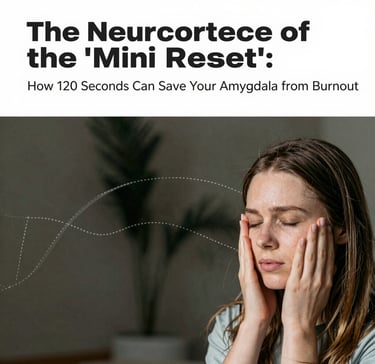
We have all been there: it is mid-afternoon, you have spent hours toggling between spreadsheets, clinical notes, or client sessions, and suddenly your brain feels like it has fifty open browser tabs—and three of them are playing music you cannot turn off.
In clinical psychology, we often see people trying to fight this cognitive fatigue with brute force. We tell ourselves to "just power through" or grab a third cup of coffee. But from a neurological standpoint, trying to push through cognitive depletion is like revving an engine that is out of gas. It does not produce progress; it just damages the engine.
Today, let us look at the neuroscience of attention fatigue and explore a practical, evidence-based tool that takes exactly two minutes to reset your nervous system.
The Tug-of-War in Your Brain
To understand why we burn out during the day, we have to look at two primary neural networks that govern our focus:
The Central Executive Network (CEN): This is your brain’s high-performance processor. It handles goal-directed focus, analytical thinking, and decision-making. Operating the CEN requires immense energy, heavily draining your prefrontal cortex (PFC).
The Default Mode Network (DMN): This network takes over when you are at rest, daydreaming, or letting your mind wander.
When you force your Central Executive Network to run continuously without a break, your prefrontal cortex becomes depleted. As your logical PFC goes offline, your brain's threat detector—the amygdala—becomes hyper-reactive. This is why a minor email typo or a slightly messy kitchen can suddenly feel like an absolute crisis by 4:00 PM.
To restore your focus, you don't need a two-week vacation. You just need to trigger a physiological "switch" to briefly deactivate the CEN and calm the amygdala.
The 120-Second "Neural Circuit Breaker"
Instead of scrolling social media during your next break (which actually continues to tax your visual and attentional processing networks), try this evidence-based, three-step reset. It is designed to rapidly shift your autonomic nervous system from sympathetic ("fight-or-flight") to parasympathetic ("rest-and-digest") dominance.
1. The Physiological Sigh (0 to 30 Seconds)
Developed by physiological researchers, this is the fastest way to reduce autonomic arousal in real-time.
Take a deep breath in through your nose.
At the very top of that breath, take one more sharp, short inhale to fully inflate your lungs' alveoli.
Exhale slowly and completely through your mouth.
Do this 3 times. This action rapidly offloads carbon dioxide and signals your vagus nerve to slow your heart rate down.
2. Panoramic Vision (30 to 90 Seconds)
When we are stressed, our vision literally narrows (tunnel vision) to focus on the threat. We can reverse-engineer this process by deliberately softening our gaze.
Look away from your screen.
Without moving your head, relax your eyes and consciously expand your awareness to your far left and far right periphery.
By engaging your panoramic vision, you biologically inhibit the brain mechanisms associated with vigilance and focal stress.
3. The "Zero-Demand" Drift (90 to 120 Seconds)
Close your eyes or look at a blank wall and let your mind go completely blank.
If thoughts drift in, let them go. Do not try to solve, categorize, or plan.
This brief period of "non-focused attention" allows your Default Mode Network to step in, giving your prefrontal cortex a micro-charge of essential metabolic energy.
The Clinical Perspective: "Self-care" does not have to be an elaborate ritual. True cognitive resilience is built in the tiny micro-choices we make between the chaos of our daily tasks.
Quick Takeaways for Your Week
Scrolling is not resting: Looking at your phone keeps your brain's focal networks highly active. A true break requires an attentional shift.
The body leads the mind: When your brain is too fried to "think positive," use your breath and eyes (the physiological sigh and panoramic vision) to physically change your brain chemistry first.
Consistency beats duration: Two minutes of deliberate neural resetting spaced throughout your day will protect your energy far better than waiting for a weekend recovery session.

Evidence-Based Consultation (EBC LLC) NPI Provider Identity: 1639783574
Address: Serving Patients Virtually Across 50+ PsyPact States | Ashburn, VA 20147
Contact: (703)727-5243 | Support@evidencebasedconsultation.com
[Privacy Policy] | [Terms of Use] | [Telehealth Consent]
© 2026 Evidence Based Consultation LLC. All rights reserved. Registered trademark property of respective owners. Evidence Based Consultation (EBC LLC) is proudly partnered with and owned by Self Knowledge Base & Foundation.Address